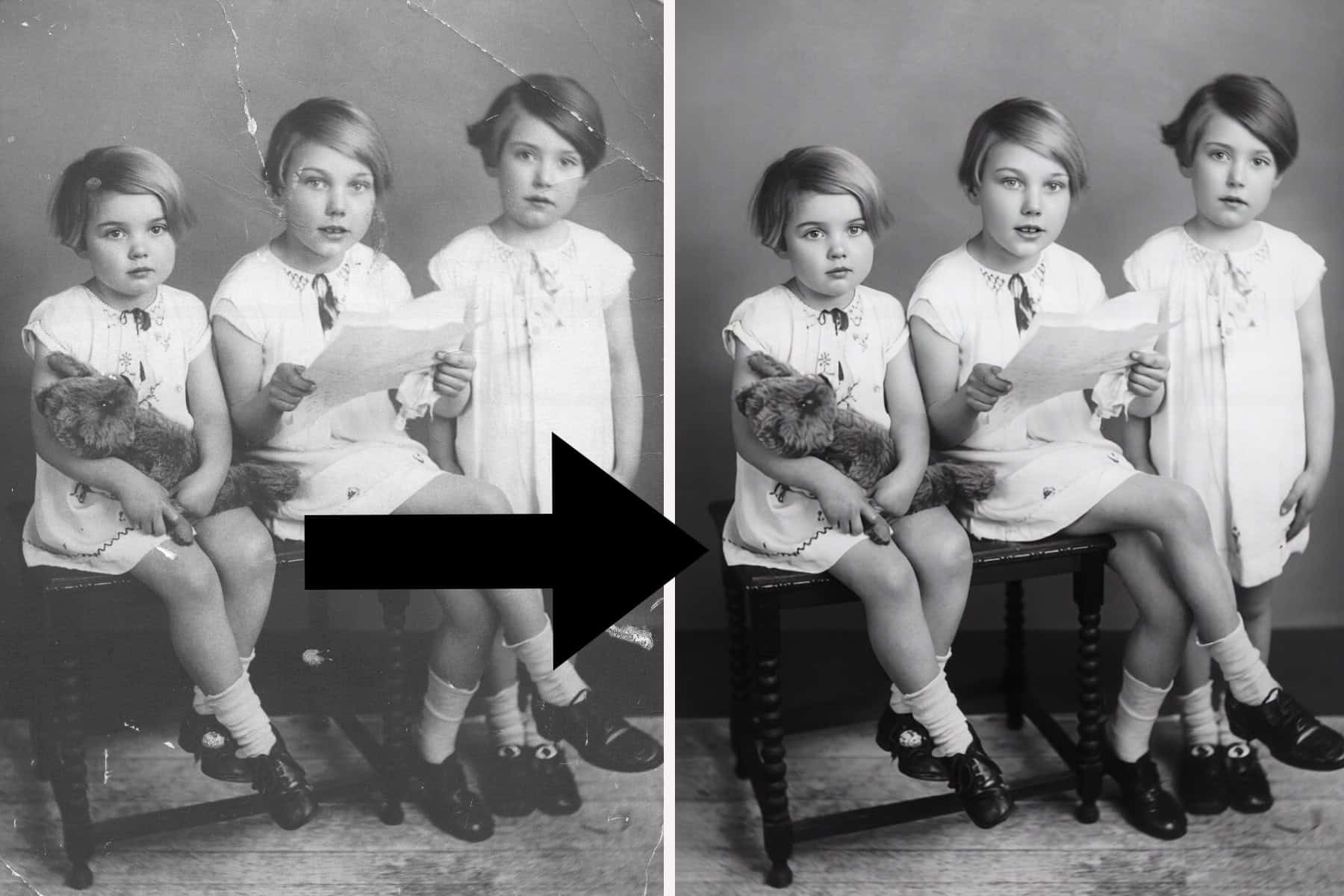
I’ve been experimenting with a new subscription AI service and one of the many, many crazy things (like putting different wedding dresses on a photo of a bride to be, changing hair colour, switching heads etc.) it can do is photo restoration. What I like about this is that for the most part it sticks pretty closely to the original image, while filling in missing details (maybe where the photo was torn or stained) as necessary, and doing a great job of removing grain, specks and so on. It doesn’t change the faces – well, not much.
I can’t see myself using the “remove all the items on the kitchen counter” or “remove the damage on a car body”, let alone “add damage to a car body” (huh?) – but given that I once spent two or three hours fixing creases and a tear on a photo of my sisters from the early 1930s, being able to do the same in a few minutes is very appealing.
As a sampler, here are four restorations I processed recently and my thoughts about each restoration, and then on AI “creations” generally (use the slider on each image):


This is the one I previously restored manually. There are minor areas where the AI has changed the facial features very slightly, but I feel this is within the bounds of historical accuracy. I never noticed them until I looked closer, using the slider feature.


This image comes from 1895. The photo is in pretty good shape, and while the restoration looks good, it doesn’t look “old” enough – maybe the restoration did too good a job! I should try restoring the sepia tone.


This is another photo where I’d go with the original, but I doubt if anyone would complain if they’d never seen the original.


Now this is the one where the service earns its money. I can’t conceive of any manual process that could “save” this photo. I would think it would have to be salvaged pixel by pixel, and at that point could one say that the result was the same photo? I don’t think so, and the cost would preclude the restoration being ever done. Certainly my wife, who is into genealogy, would not have paid to have a better image of my grandfather than the one generated here.
So my overall reaction is two-fold. Firstly, as a techie, I’m blown away with what it can do, Secondly, while I’ve played with AI to “create” something, I’ve only ever got momentary satisfaction from doing that. I don’t feel like any kind of creator with AI ‡, but I’ll use it as a tool to save myself time, or to do something I wouldn’t bother to do otherwise.
For instance, I wrote a review of some other software I use to help out the author, but when I went to paste the same review into Google Play there was a 500 word limit. I might have just said, “Too bad” but I threw it into AI and asked it to summarise it in 500 words, did a little editing and – done. When I think about the boxes of photographs we have, my reaction is “Too bad! (Someone else’s problem)” but with this tool a few torn, stapled or spindled photos will get saved, and no-one is going to complain they’re not genuine, especially once the original gets thrown out.
‡ However, I do get a creative buzz from visualising something funny and making that with AI – like having a cake decoration Santa come to life, walk across the Christmas cake and come sliding down the edge! I created the idea and AI made it real. I didn’t just keep pressing enter until something good showed up.
AI is fine so long as you understand its limitations. And you don’t get to understand it without playing with it. So if while you’re playing – I mean researching – and you find something like this photo restoration function which is really useful – bonus.