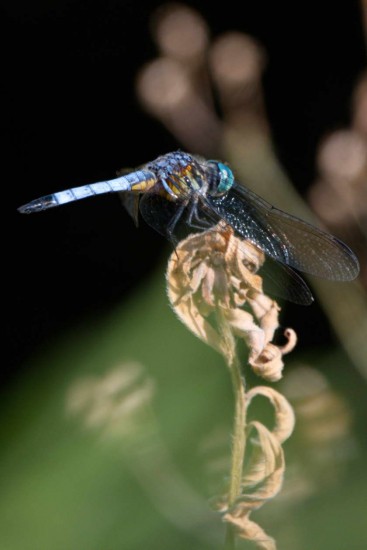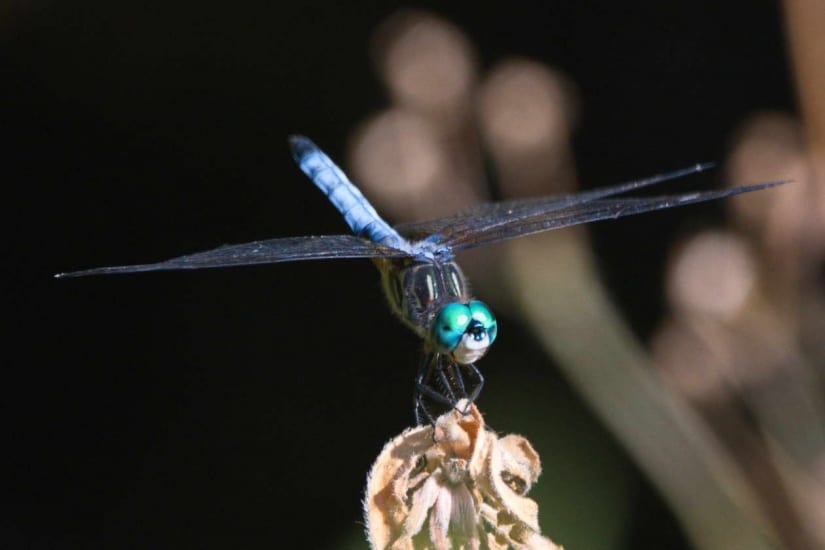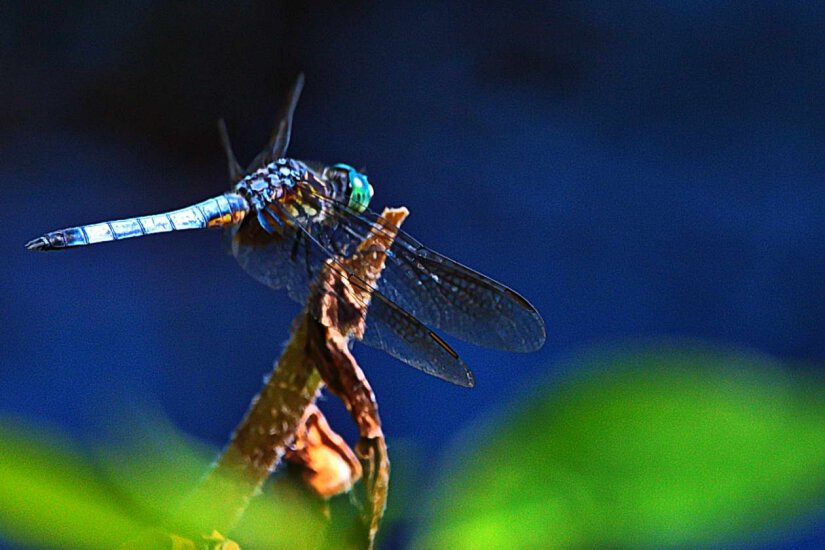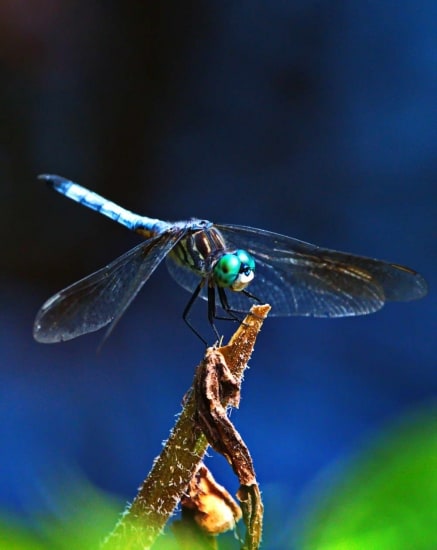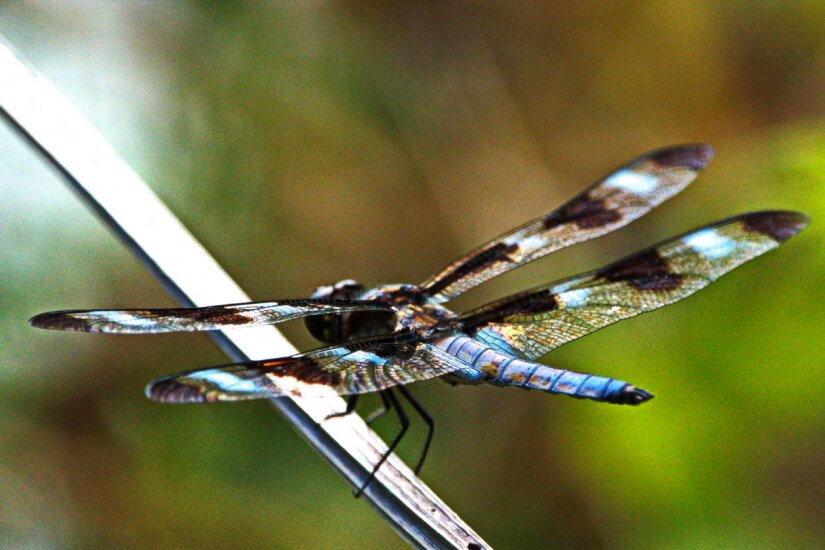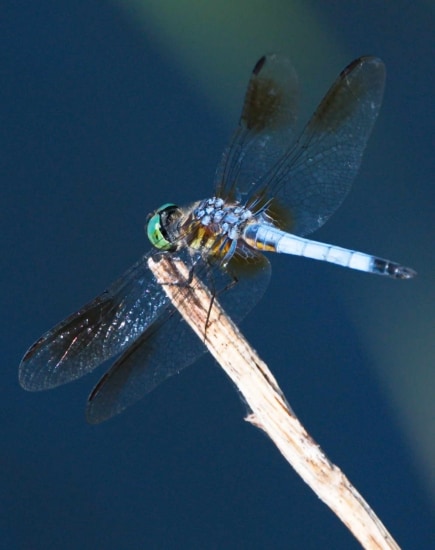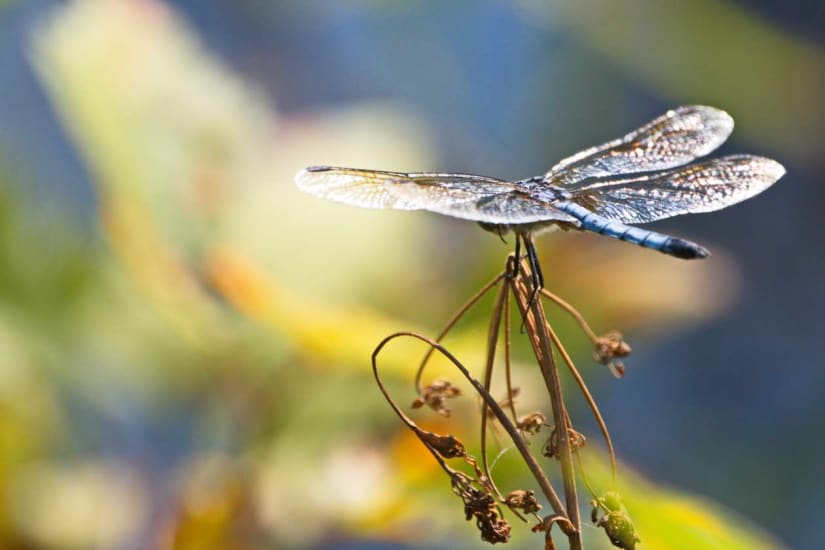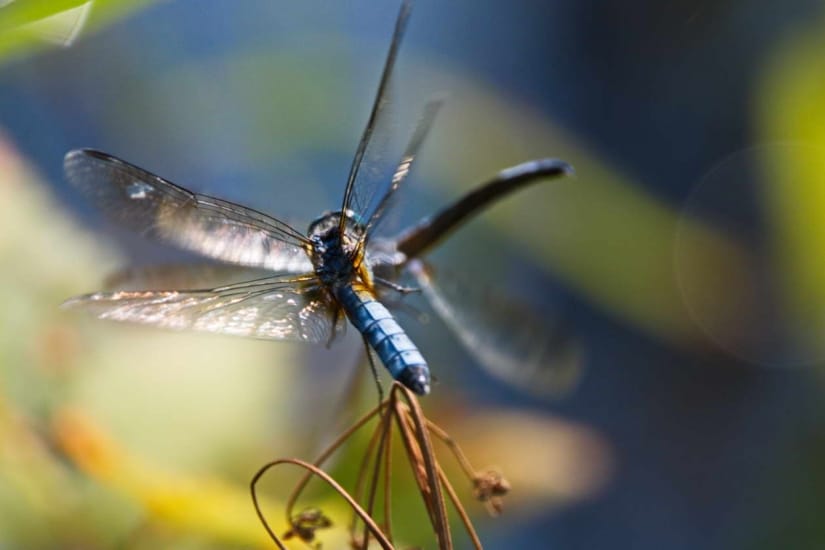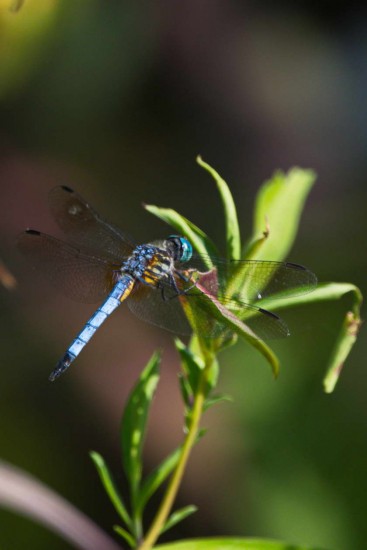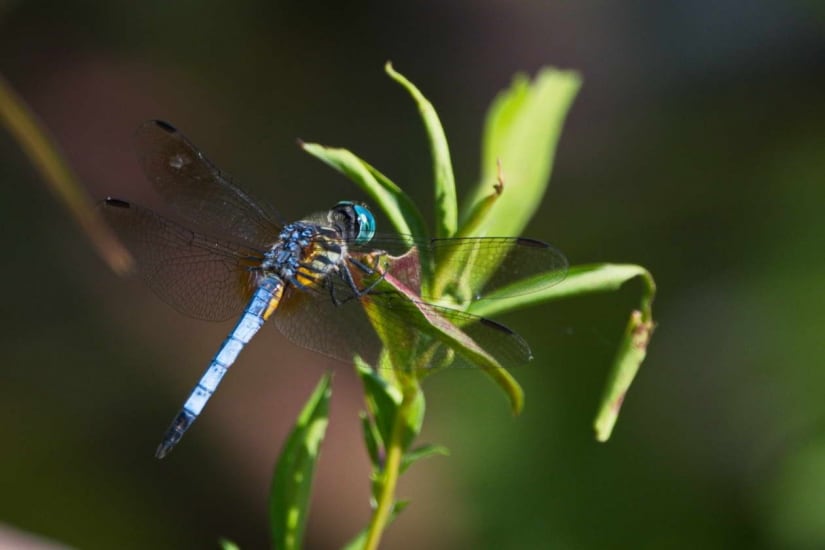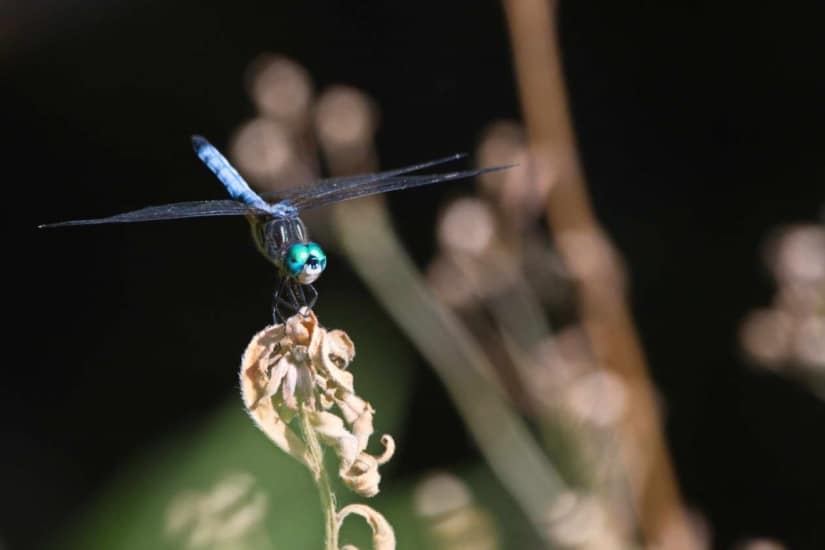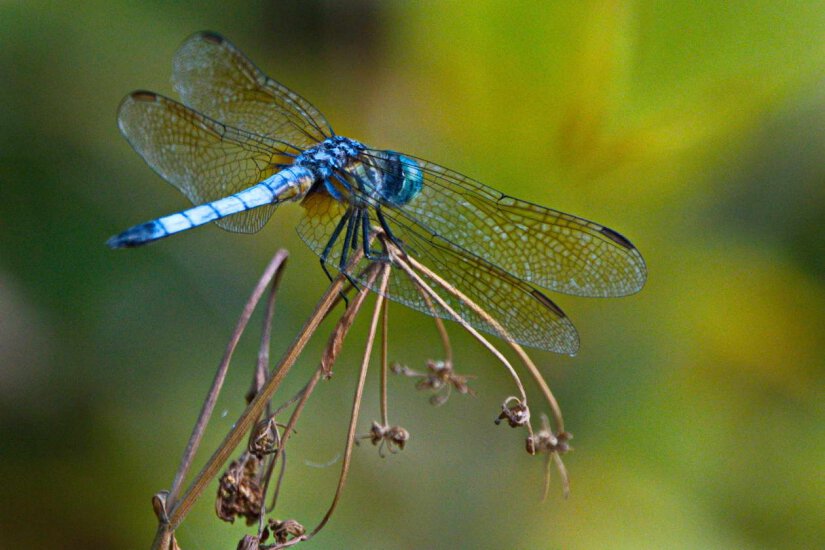
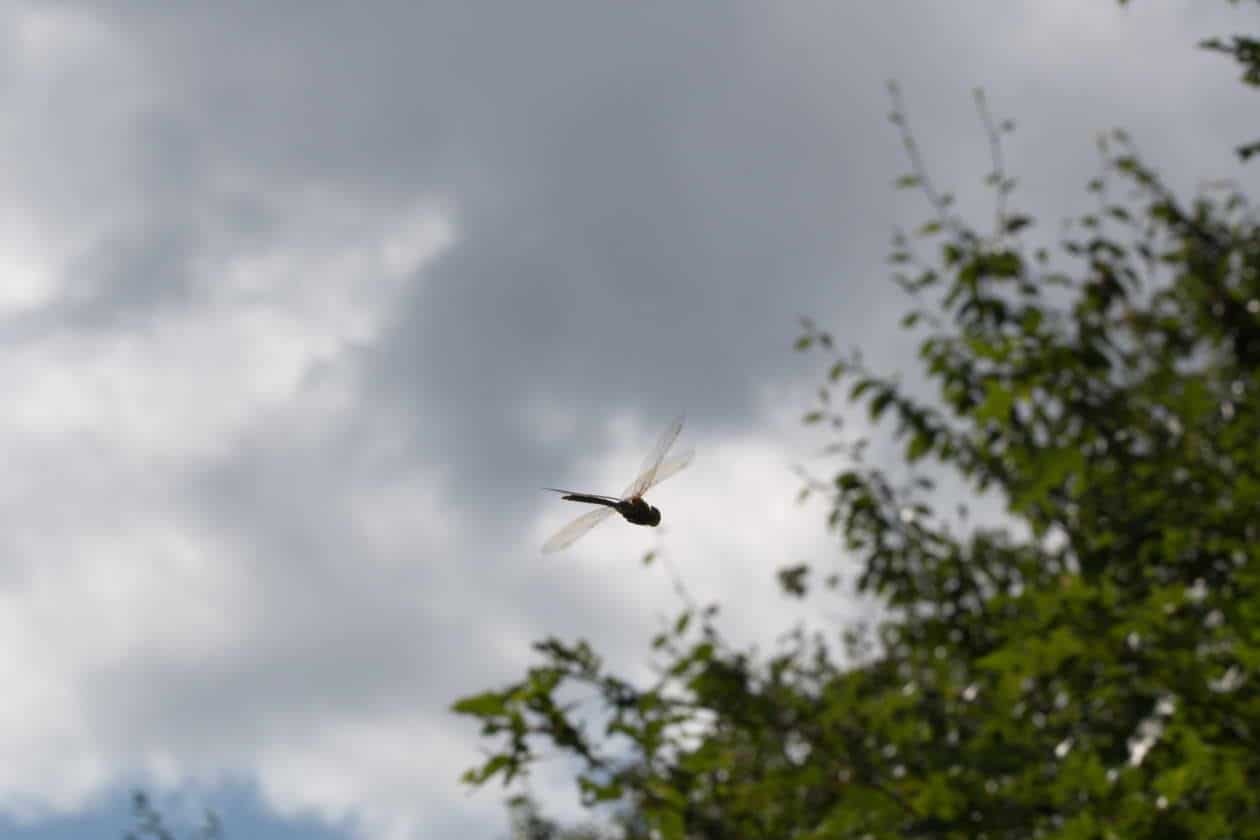
Sitting on the back deck on late Summer afternoons, there always seems to be a dragonfly flitting to and fro. They are way too fast and unpredictable to capture in flight, and they don’t seem to ever alight, so my challenge was how to get a decent photo.
[Jump right to the photo gallery!]
How to train your dragonfly
Well, you can’t. So far as I can tell, they eat mosquitoes. My niece helpfully suggested that I drop my blood in a likely spot, wait for mosquitoes, and then wait for dragonflies to come to eat the ‘squitoes. I promised to consider that, but I didn’t say how seriously. Instead, I took my camera to a place with more dragonflies. A local rainfall management area, aka “The Pond”.
First dragonfly hunt
There are several places around the pond where the vegetation is sparse enough for a clear view. Late afternoon seemed like a likely time, mostly because that was when I was free, and besides, I never saw dragonflies in the morning when I walked the dog. After standing relatively still for a few minutes, I began seeing dragonflies. Gradually I got better at tracking them, and finally, as my eyes and brain got better at recognizing them, I found that some of them did stop for a rest. Now I had a chance for a photo.
Experiencing technical issues
I had fitted my longest telephoto lens, a Sigma 150-600 mm zoom, as I rightfully thought that (a) I would not get very close and (b) an effective dragonfly photo was not going to be one with 1% insect and 99% background. Now this lens is often nicknamed the “Bigma” due to its weight and length. Issue number one was holding the lens and camera for any length of time. I hadn’t brought a tripod, because I thought the timing would be critical. I had also selected what Nikon calls “Group” focusing, which uses nine focus sites, as this had proved to be reliable when tracking birds in flight. It wasn’t until I got back to a large viewing screen that I found that getting a dragonfly’s shoulder or wing in focus wasn’t good enough if the face and especially eye was not sharp.
However, on this day, I got a number of images which were not too shabby, and I even published one, with the notation that objective one had been achieved; that is, getting a dragonfly photo. I also said that my next objective was to get a crisp dragonfly photo.
I also found that carrying a big lens and camera around for an hour, a few days after trying rock-wall-climbing at a local gym had consequences. Not good ones.
First trip results
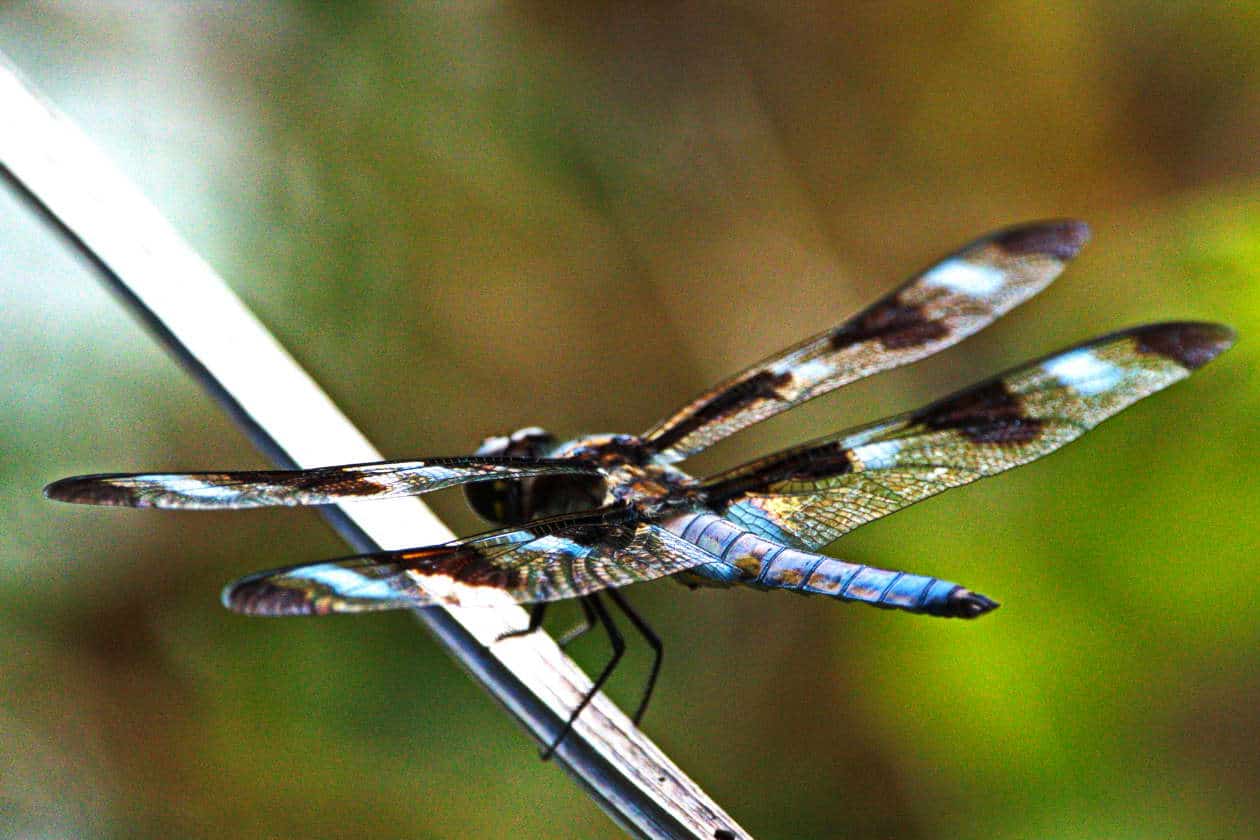
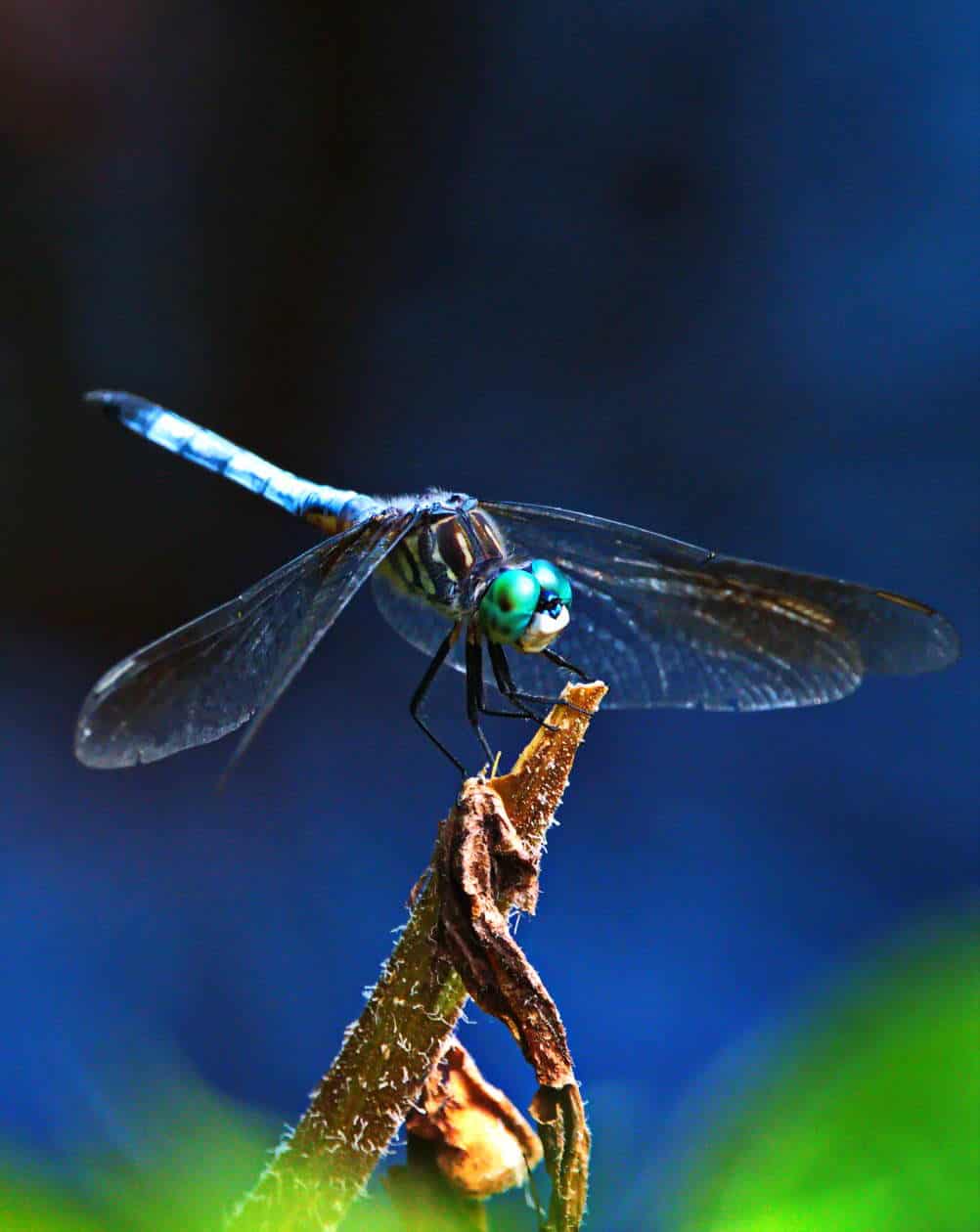
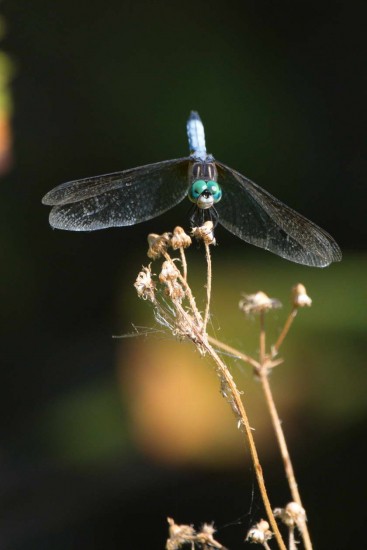
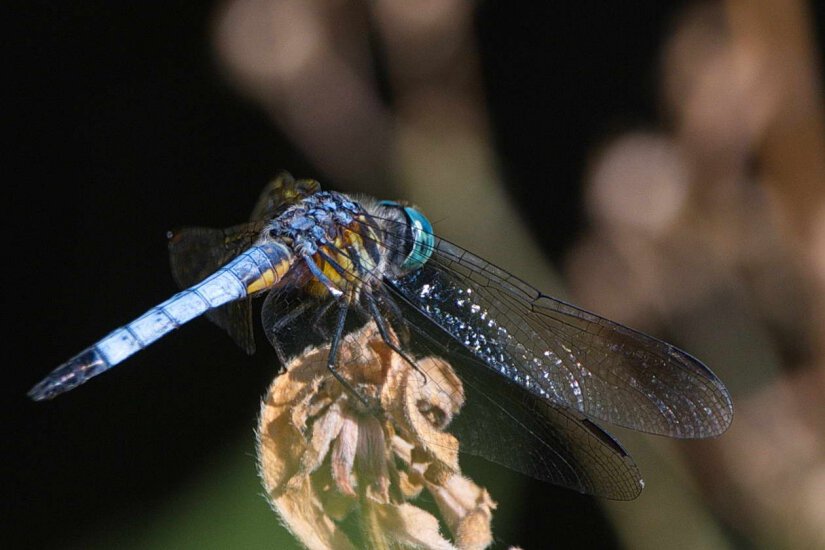
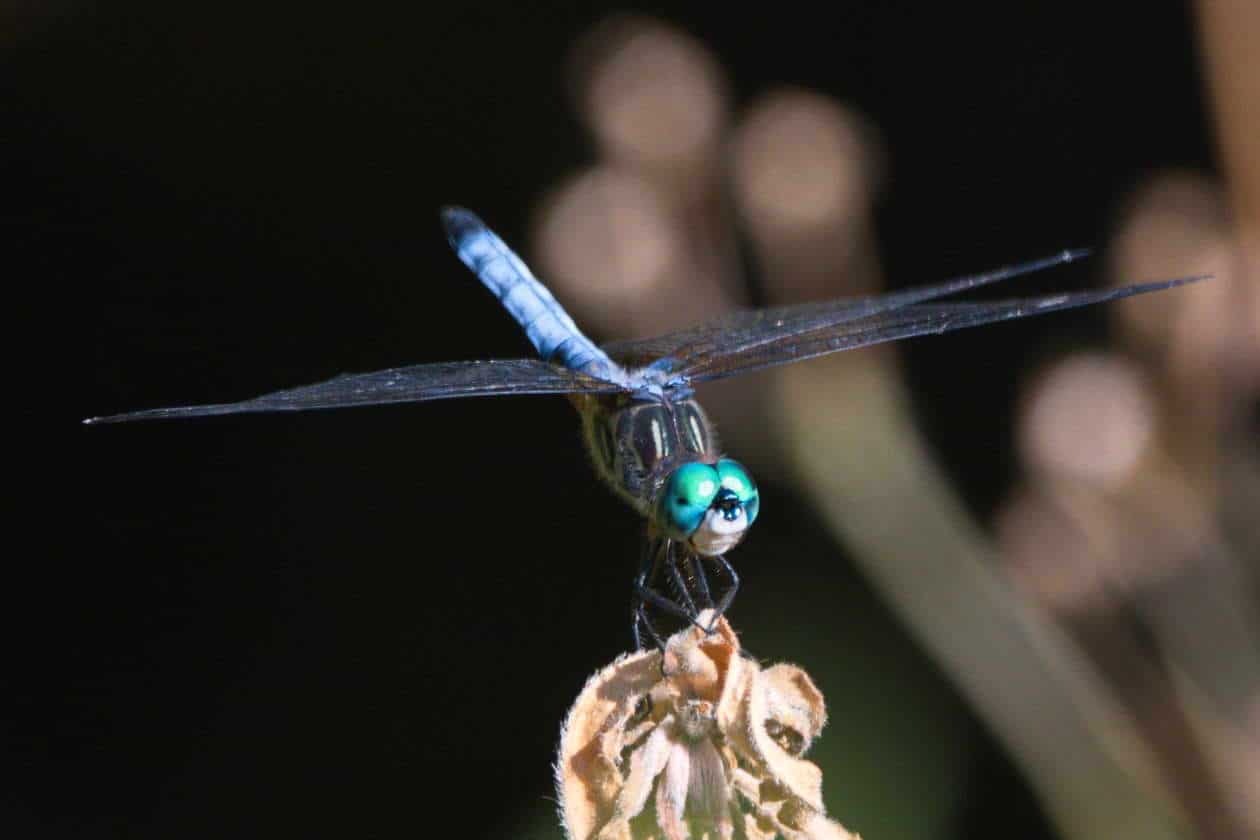
The keepers from my first trip were not too bad, but the whole point of a photo like this is to show the beautiful detail, and people tend to look at the eyes. Where the head is turned away, the wings and tail can be admired, but for myself, I still want to see the head in focus. On the rare occasion that the thing sat facing me, the group focusing mode “found” the twig instead and those beautiful turquoise eyes are not sharp.
Second trip – dragonfly behaviour
On this trip, I found out a bit more about dragonfly behaviour. First, only the smaller ones seem to rest. The big ones, 1-2 inches in length never seem to stop. Maybe they do so in secluded locations. I imagine they make a more worthwhile meal for the birds and other predators, and the one who are left have learned to be cautious!
The ones that do perch like to do so at or near the tip of a twig or leaf, and they keep coming back. The twig I discovered within minutes of arriving at the pond was occupied forty minutes later when I passed by again.
I found that moving slowly, I could stay within about ten feet without disturbing their rest. In fact, at one point I had to move back because the lens would not focus that closely.
Camera setting changes
For this trip, I mounted the lens on a tripod, and took a corded release. I set the focus mode to spot instead of Group and about halfway through the session decided to change the exposure to spot metering also. Starting at 1/1600 sec, I later changed to 1/640 sec for better exposure. I set the ISO to 640.
One thing I found was that my ball and socket head would creep after I tightened it, so if I aimed at the end of a twig, after it settled, the twig end was no longer centred, but was up in the top half of the image. I discovered later that I didn’t need to worry too much about that as most of the image was going to get cropped away. Instead of trying to get the focusing spot centred on the subject using the ball and socket adjustment, I would get it close and then move the focusing spot to the subject!
I also had problems finding the subject (either a settled dragonfly or a twig end) because of the very narrow field of view, and the shallow depth of field. I could be pointing the lens in the right direction, but if it was focused behind the subject, I’d never see it. As I got more accustomed to the habits of the dragonflies, and how they looked in the viewfinder, I got better at being able to quickly adjust to a new location.
For some of these shots, I was using the tripod as a monopod, with the ball-head fairly loose. For those shots, I turned the optical stabilizer back on, and in so doing also found that it had previously been in a “vertical stabilization only” mode (I wish they would label them modes better than “1” and “2”!) which may have accounted for some of the fuzzies in trip one results.
Results from the second dragonfly hunt
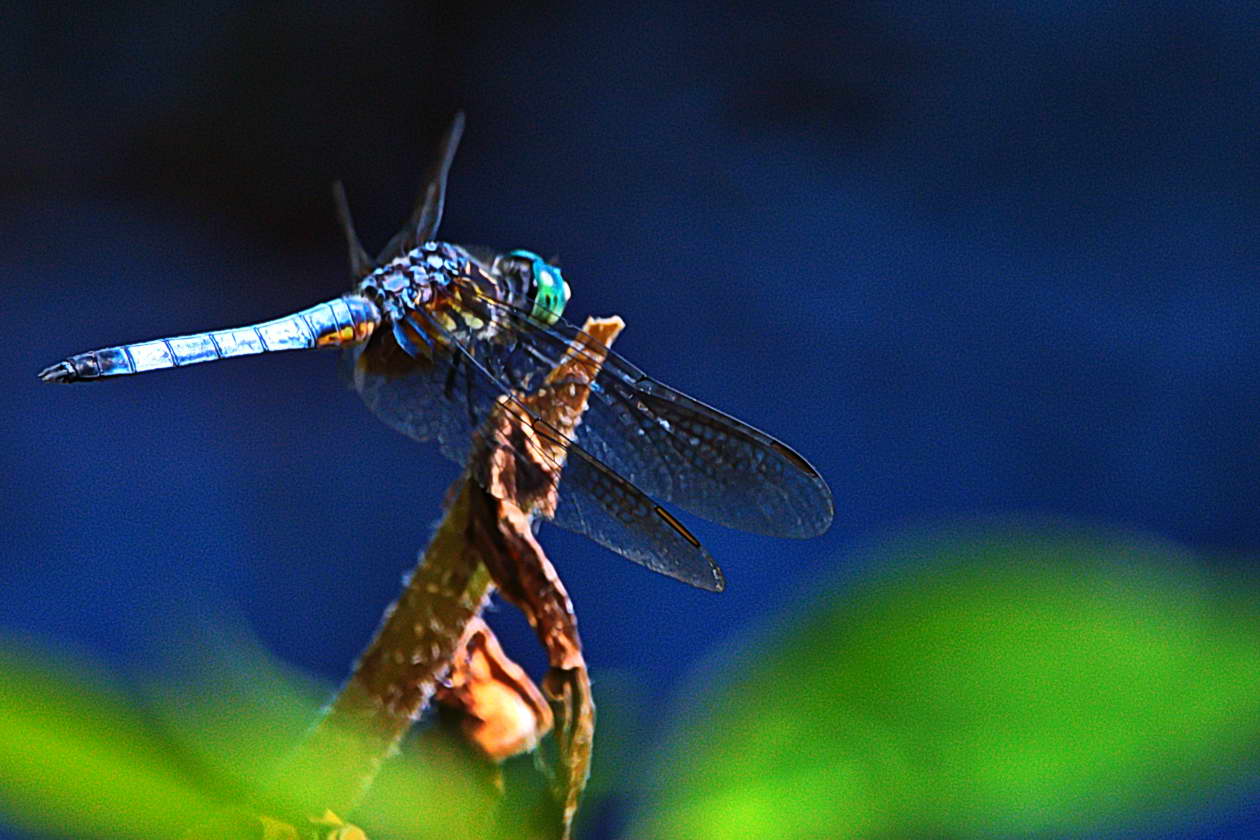
I’m quite happy with the shots I got yesterday. Out of 42 dragonfly images, I initially kept 35, and these got whittled down to 18 keepers, to avoid unnecessary duplication. That’s a pretty good batting average for me! I might try using a flash so that I can use a smaller aperture and thus a larger depth of field, but other than that, I’m not sure what else I’d change.
Now if only I could find out where the big guys hang out when they’re not buzzing around!
Enjoy the gallery below from my second trip. These look best on a big screen, and if you click on any one, it will enlarge and let you scroll through sequentially.